Launching a startup in the electronics and smart hardware space is one of the most exciting— and daunting — entrepreneurial journeys that can be undertaken today. The market is fast-paced, technologies evolve quickly, and investors want to see quick milestones. But a successful product launch is built on the foundation of a dependable supply chain.
For lots of founders, the road to finding components and manufacturing partners in China is paved with questions. Rapid timelines, multiple design shifts, and budget constraints can kill even the most breakthrough ideas.
In this guide, we cover the top 5 challenges startups face today, why China remains the electronics mecca of the world, and how Connected Sourcing, a Kinara International brand, provides startups with the opportunity to feel confident and secure as they transition from concept to mass production at lightning speed without compromising quality.
The Harsh Reality: Challenges Startups Face in Sourcing
1. Constant Design Iterations
In early hardware projects, no prototype is sacred. Designs are often pivoted on by startups depending on testing, investor feedback, or new technical findings. That’s because suppliers will have to be flexible enough early on for small-batch prototyping, but then be able to scale up later. Tragically, many factories are set up to handle either small runs or mass production, but not both.
2. Tight Development Cycles
Electronics and smart device companies face pressure. Investor deadlines, trade show launches, crowdfunded projects – they don’t allow for anyone to be only human. A two-week setback in PCB production or case mold creation can undo months of planning.
3. Cost vs. Quality Dilemma
Startups must stretch every dollar, and cutting corners with components can result in product failures, recalls, or negative customer reviews. The key is to have suppliers that provide flexibility and balance cost with reliability.
4. Certification and Compliance
Smart hardware will typically need to meet rigorous certifications, such as CE and RoHS (Europe), FCC (US), and even medical device approvals if applicable. Many new companies underestimate the difficulty of getting suppliers up to these standards.
5. Lack of Transparency
Founders often struggle with visibility. What are the parts actually made from? What kind of quality checks are being made? How can they track progress, from the moment an order is placed until it is delivered? Without transparency, trust erodes quickly.
Why China Remains the Go-To Hub for Electronics Startups
Despite the challenges, China — especially the Guangdong province triangle of Shenzhen, Guangzhou, and Dongguan City — remains unmatched for electronics and smart hardware startups.
Shenzhen: Global hub for PCB manufacturing, IoT innovation, and electronic components. Huaqiang North Marketplace is also based in Shenzhen.
Dongguan: Precision machining, plastics, and OEM assembly capabilities.
Guangzhou: Logistics gateway with mature freight networks for global exports.
In addition, the region hosts an integrated ecosystem: PCB fabrication, 3D printing, injection molding, metal machining, and final assembly can all be found within a short distance. This clustering effect drastically reduces lead times and enables rapid iterations.
For startups, this ecosystem is invaluable — but navigating it without local support is daunting.
Practical Sourcing Tips for Electronics & Smart Hardware Startups
Startups often ask: “What should we look out for when sourcing from China?” Based on 20+ years of experience, here are seven key lessons:
1. Choose Suppliers Based on Stage
EVT/DVT: Work with agile factories that accept low volumes and frequent changes.
PVT/MP: Shift to larger suppliers with stable QC and scalable capacity.
Don’t expect one factory to excel at both prototyping and mass production.
2. Validate Before You Commit
Always conduct sample testing and factory audits before scaling. Use third-party audits or local sourcing teams to confirm supplier claims.
3. Manage Costs Beyond Unit Price
Factor in tooling, certification, packaging, logistics, and after-sales support. Sometimes a slightly higher per-unit cost means fewer hidden expenses down the line.
4. Shorten Prototyping with Parallel Workflows
Run PCB development and casing prototyping in parallel using 3D printing and CNC. This approach can save weeks in the product timeline.
5. Plan Certifications Early
If your product needs CE, FCC, or medical approvals, involve experts during EVT. Retrofitting compliance later may mean redesigns and costly delays.
6. Build Transparency Into the Process
Set up clear reporting structures: weekly updates, production photos/videos, and QC reports. This reduces misunderstandings and reassures investors.
7. Protect Your Intellectual Property (IP)
IP protection is critical for startups sourcing in China:
Sign NDAs before sharing design files or PCB layouts.
Use contracts that clearly define IP ownership — including modifications.
Split production (e.g., PCB at one factory, casing at another) to avoid giving away the entire design.
Register trademarks and patents in China to prevent copycats.
Provide files selectively — only what each supplier needs.
We’ve seen startups lose control of designs because they skipped contracts or didn’t secure local IP. Early safeguards save major headaches later.
Connected Sourcing: Turning Challenges into Opportunities
As part of Kinara International, Connected Sourcing bridges the gap between ambitious startups and China’s world-class supply chain. Our advantage is threefold:
1. End-to-End Supply Chain Expertise
With Kinara’s 20+ years of global supply chain experience, we provide a complete service stack:
Product Development Support – Turn ideas into prototypes, prototypes into validated products.
Strategic Sourcing – Identify the right factories across PCB, OEM, plastics, and components.
Supplier Due Diligence – Factory audits, compliance checks, IP protection measures.
Price & Term Negotiation – Ensure cost-efficiency without sacrificing quality.
Risk Control – Data-driven risk management to mitigate disruptions.
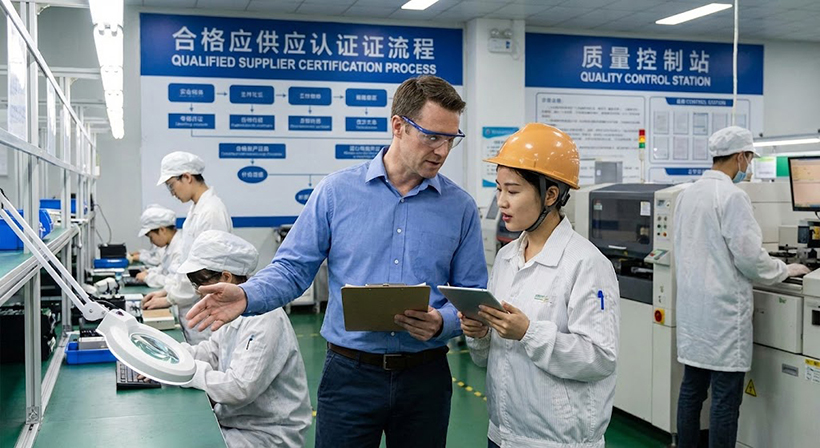
Manufacturing Oversight – On-site QC teams to ensure standards are met.
Logistics & Fulfilment – From China to the UK, EU, Middle East, or beyond.
After-Sales Support – Long-term reliability, not just transactional sourcing.
2. Embedded in Guangdong’s Ecosystem
Our sourcing team is based in the heart of China’s electronics manufacturing ecosystem, with direct access to:
PCB fabrication plants
OEM & ODM assembly lines
Electronic component suppliers
3D printing & rapid prototyping hubs
Metal and plastic processing workshops
This allows us to provide faster lead times, lower costs, and better quality control compared to remote-only sourcing firms.
3. Tailored for Startups
We understand startups operate differently from large corporations. That’s why our model is designed for:
Flexibility – Handling small prototype batches before scaling to mass production.
Transparency – Clear progress tracking, supplier visibility, and milestone reporting.
Agility – Ability to pivot quickly when designs change.
Compliance Support – Assistance with certifications for medical, consumer electronics, and IoT devices.
Case Study: From Idea to Global Market – A UK Smart Wearable Success Story
When a UK-headquartered health tech start-up contacted us with the idea of creating a medical-grade smart wearable, it was still in concept mode. Their in-house team came up with good product and medical ideas, but no know-how around supply chain and local China connections to turn such ideas into real products.
Step 1: Concept & Supplier Mapping
From the outset, we worked closely with their engineers to translate product specs into sourcing requirements. This involved:
Identifying certification-compliant PCB suppliers.
Selecting casing manufacturers with experience in biocompatible plastics.
Mapping secondary suppliers (battery cells, sensors, straps) to reduce dependency risks.
Step 2: Rapid Prototyping & Iterations (EVT)
The client needed a working prototype for investors within 8 weeks. We coordinated with PCB and OEM suppliers in Shenzhen and Dongguan, enabling parallel development of boards and casings. Using 3D printing and CNC prototyping, we delivered models within days, allowing rapid iteration.
Step 3: Small-Batch Validation (DVT)
We oversaw production of 50 functional prototypes, tested for:
Sensor accuracy in medical data collection.
Battery stability under continuous use.
Durability of casings under daily wear.
Our Guangdong-based QC team flagged issues early and ensured corrections before scaling.
Step 4: Pilot Production (PVT)
Scaling to 2,000 units introduced new complexities. We introduced:
Supplier audits to verify capacity and compliance.
A quality tracking system linking units to batches and suppliers.
EU MDR-compliant packaging and labeling.
Step 5: Mass Production (MP)
With Series A funding secured, we managed a run of 100,000 units across two factories. Connected Sourcing coordinated:
Multi-factory allocation to balance risk.
Full QC inspections from materials to packaging.
Global logistics planning for on-time delivery to Europe.
Step 6: Certification & Market Entry
Certification was critical. We worked with agencies to ensure suppliers provided full documentation and traceability. This proactive approach saved months of back-and-forth with auditors.
The Outcome:
Product launched on schedule and within budget.
Investors gained confidence with a certified, working product.
Startup successfully entered the European market with strong early sales.
What began as an idea became a globally certified product line — with Connected Sourcing as their supply chain partner at every step.

Why Choose Connected Sourcing for Your Startup?
Unlike many sourcing agents who focus only on transactions, Connected Sourcing acts as an extension of your startup team, bridging the gap between innovation and execution.
Proven Experience in Electronics & Smart Hardware – From IoT devices to medical-grade wearables, we know how to source sensitive components, navigate compliance-heavy industries, and support full lifecycle management.
Local Presence in China’s Manufacturing Hubs – Direct access to Shenzhen, Guangzhou, and Dongguan suppliers ensures speed, flexibility, and visibility.
Transparent & Flexible Process – Progress tracking dashboards, clear cost structures, and tailored engagement models.
Global Reach with Kinara’s Network – Operations across the UK, Germany, Dubai, China, the Philippines, and India, backed by 20+ years of expertise.
Proven Track Record of Scaling Startups – Helping companies grow from a handful of prototypes to 100,000+ units.
When delivering the next smart wearable, IoT device, or consumer electronics innovation, Connected Sourcing can help you move faster and reduce risks as you scale with confidence.
Get in touch with us to talk about your project — and find out how we can be the supply chain partner you’re looking for from prototype through production.
Frequently Asked Questions
1. How can startups protect their intellectual property (IP) when sourcing from China?
Protecting IP is one of the top concerns for electronics and smart hardware startups. The best approach is a layered one:
Sign NDAs with every supplier before sharing sensitive files.
Use contracts that clearly state IP ownership, including any design modifications made during prototyping.
Limit information sharing by giving each supplier only the files relevant to their part of the project.
Register trademarks and patents in China — foreign registrations often don’t apply locally.
Consider splitting production (e.g., PCB from one factory, casing from another) to avoid giving a single supplier full visibility.
Connected Sourcing implements all these safeguards on behalf of our clients, reducing the risk of IP leakage or copycats.
2. What is the biggest mistake electronics startups make when sourcing from China?
One of the most common mistakes is that a lot of startups stick with their prototype supplier through mass production, and end up facing one of the Plagues of Manufacturing (poor quality, late delivery, or not enough capacity).
Prototyping needs agility and flexibility; mass production requires rigorous QC systems, certification, and the ability to scale.
Another mistake is shortchanging certification – often, you’ll see folks say, “Oh, we’ll do CE/FCC/RoHS at the end.” This ultimately means a redesign and some surprises.
With Connected Sourcing, startups can avoid these mistakes by pairing them with the right manufacturer for their current stage and building compliance planning into their process early on.
3. How can startups manage costs effectively while ensuring product quality?
Startups should look beyond the per-unit price. True cost management includes:
Tooling and mold fees
Certification costs (CE, FCC, RoHS, ISO, medical approvals)
Packaging, logistics, and after-sales expenses
Choosing the cheapest option often leads to hidden costs such as rework, delays, or warranty claims. The better strategy is to work with reliable suppliers who deliver consistent quality — even at a slightly higher unit cost — because this lowers the total cost of ownership.
Connected Sourcing negotiates favorable terms and manages the entire cost structure, ensuring startups maximize value without sacrificing quality.