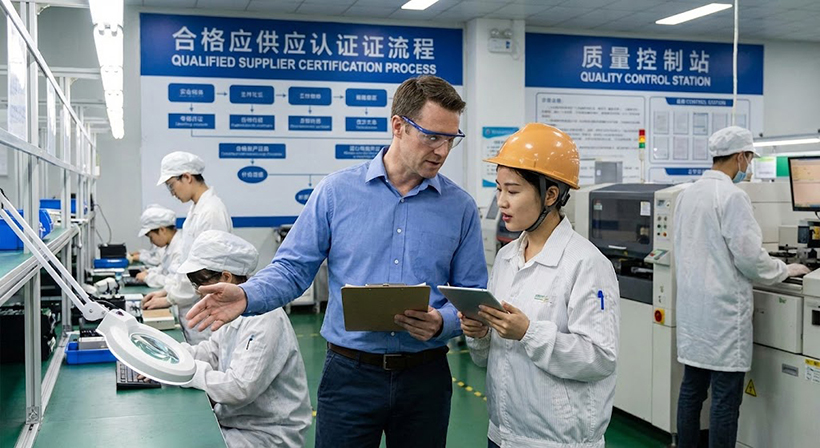
Verifying suppliers in China has never been more important. As global demand increases and more trading companies pose as factories, the risks for UK, EU, and UAE businesses rise each year.
This 2025 Guide shows you exactly how to verify suppliers, avoid scams, confirm legitimacy, and reduce production risk before placing an order.
Table of Contents
- Why Supplier Verification in China Matters in 2025
- Step-by-Step Guide to Verifying Suppliers in China
- Step 1 — Verify the Business License
- Step 2 — Confirm Factory Identity
- Step 3 — Check Production Capacity
- Step 4 — Review Certifications
- Step 5 — Conduct a Factory Audit
- Step 6 — Request Samples and Test Them
- Step 7 — Review Export History
- Step 8 — Validate Quality Control Systems
- Step 9 — Financial Stability Check
- Step 10 — Evaluate Communication
- Common Supplier Red Flags
- What a Verified Supplier Should Provide (Checklist)
- Why Connected Sourcing’s Vetting Reduces Risk
- FAQ
- Download the Supplier Verification Checklist
Why Supplier Verification in China Matters in 2025
Manufacturing opportunities in China remain enormous, but so do the risks if you don’t verify the supplier before paying deposits.
Why verification matters now:
More trading companies pretending to be factories
- Rising material manipulation and quality fade — explained in our article: What Is Quality Fade?
- Compliance demands (CE, UKCA, REACH) stricter in UK/EU
- Increased fraud risks on marketplaces
- Higher costs if you choose the wrong supplier
A structured verification process protects your budget, timelines, and brand reputation.
Step-by-Step Guide to Verifying Suppliers in China
Step 1 — Verify the Business License
Every legitimate Chinese factory MUST have a valid business license (营业执照).
Check for:
- Unified Social Credit Code (18 digits)
- Official registered name
- Address (must match factory location)
- Business scope (“manufacturing” must be included)
Pro Tip:
Ask for a clear photo of the license, not a blurry screenshot.
Step 2 — Confirm Factory Identity
To avoid trading companies pretending to be factories:
Ask for:
- Production line photos
- Factory floor videos
- Machine list
- Staff count
- Organization chart
Cross-check the address using Baidu Maps or Google Satellite View.
 If the company resists, it’s a red flag.
For deeper validation, see: 3 Proven Methods for Sourcing Products from China
Step 3 — Check Production Capacity
To avoid trading companies pretending to be factories:
Ask for:
Daily/weekly output
Number of production lines
Lead time per batch
Automation level
Example past orders
Step 4 — Review Certifications
Relevant for your product type:
- CE
- UKCA
- RoHS
- REACH
- ISO 9001
- Specific industry standards
Request:
- Previous test reports
- Lab names (SGS, TUV, Intertek, BV, etc.)
If certifications look fake, cross-check the serial number.
Step 5 — Conduct a Factory Audit
Audits dramatically reduce risk.
For a deeper guide, see:
Why & How to Conduct Factory Audits in China
Audit items include:
- Factory layout
- Worker conditions
- QC systems
- Storage & packaging
- Compliance and safety
- Production capability
Frequently Asked Questions
Do I Need to Speak Mandarin?
Not necessarily! But understanding these tips and potentially partnering with a Mandarin-speaking sourcing agent can make things a lot easier.
What if My Supplier Doesn't Speak English Fluently?
Many global sourcing companies offer translation and interpreter services. Consider working with a sourcing agent who can manage communication for you.
Is WeChat the Only Way to Communicate?
While WeChat is popular, email is still widely used. The best method depends on your supplier's preference. Discuss communication methods during the planning stage to find a solution that works for both of you.
Why Use a Sourcing Company?
Sourcing companies can bridge the language gap, translate documents, handle negotiations, and ensure clear communication throughout the process. This frees you up to focus on other parts of your business, knowing communication is running smoothly.
By following these communication best practices, you can bridge the gap and build strong, successful partnerships with Chinese manufacturers. Remember, clear communication is the foundation of any global sourcing journey.
Connected Sourcing can help you navigate your sourcing process by providing an end-to-end solution, including communication with your suppliers. Contact us today to learn more!